Riichi Mahjong
Riichi Mahjong is the Japanese form of Mahjong. It combines tile efficiency, defensive reading, Yaku, Fu, Han, and table position in a precise four-player game.
Riichi Mahjong Tiles
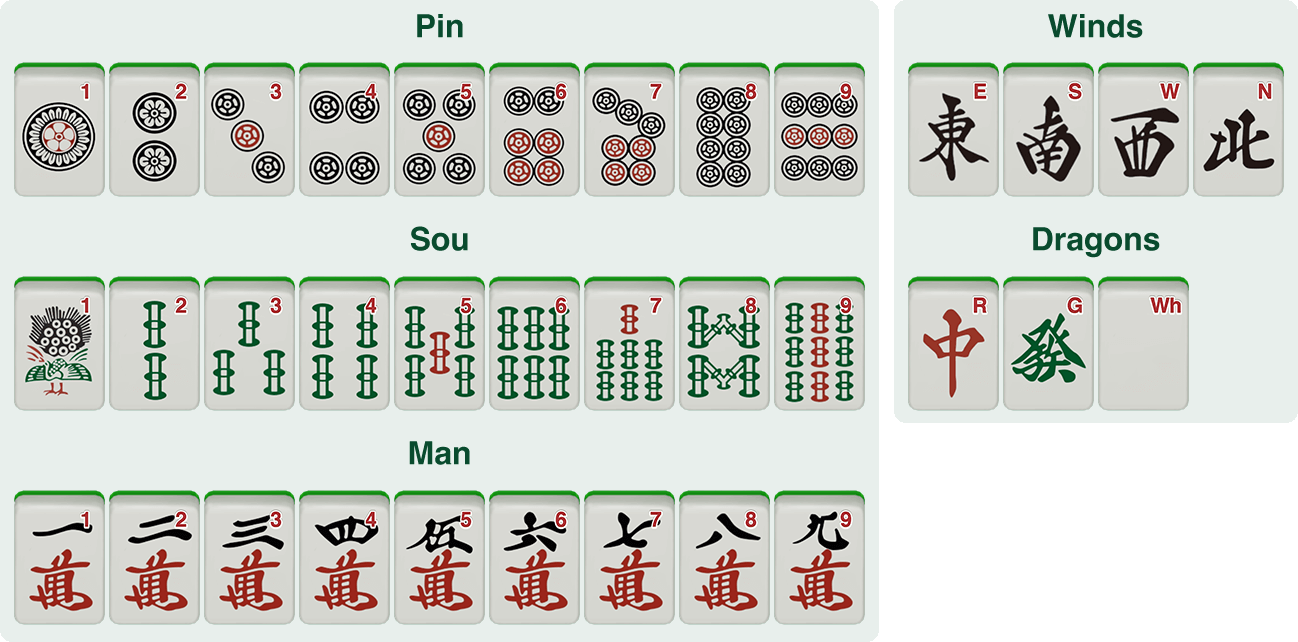
A standard set has 136 tiles: Pin (circles), Sou (bamboo), Man (characters), the four Winds, and the three Dragons. Flower and Season tiles are not used. Players normally begin with 13 tiles and draw and discard until they complete a legal winning hand.
Some rulesets use red fives, often called red Dora: the red 5 Pin, 5 Sou, and 5 Man. Each red five in a winning hand adds one Han. Red fives are optional, so their number depends on the table rules.
Riichi Mahjong Rules
A complete hand is not enough by itself: a player also needs at least one Yaku. Dora increases the value of a valid hand, but Dora alone is not a Yaku.
- Riichi: With a closed hand in tenpai, a player may place a 1,000-point stick and declare Riichi. Riichi is a Yaku and generally locks the hand until the round ends.
- Dora: A revealed Dora indicator identifies the tile that counts as Dora. Each Dora in the winning hand adds one Han; the indicator itself is not the scoring tile.
- Draw: If nobody wins before the wall is exhausted, or a special abortive-draw condition occurs, the hand ends in a draw.
Common Yaku
The list below uses common romanized names. Values shown are for closed hands where the value can change after calling; local table rules may differ.
- 1 Han: Riichi • Ippatsu • Menzen Tsumo • Pinfu • Tanyao • Iipeikou • Yakuhai • Rinshan Kaihou • Chankan • Haitei • Houtei
- 2 Han: Double Riichi • Sanshoku Doukou • Sankantsu • Toitoi • Sanankou • Shousangen • Honroutou • Chiitoitsu • Chanta • Ittsu • Sanshoku Doujun
- 3 Han: Ryanpeikou • Junchan • Honitsu
- 6 Han: Chinitsu
- Yakuman: Tenhou • Chiihou • Daisangen • Shousuushii • Suuankou • Suukantsu • Tsuuiisou • Ryuuiisou • Chinroutou • Kokushi Musou • Chuuren Poutou • Daisuushii
- Mangan: Nagashi Mangan
Riichi Mahjong Scoring
Fu Calculation
Fu measures structural details such as meld type, wait shape, pair value, and winning method. After adding the applicable Fu, the result is rounded up to the next multiple of 10, subject to special hand rules.
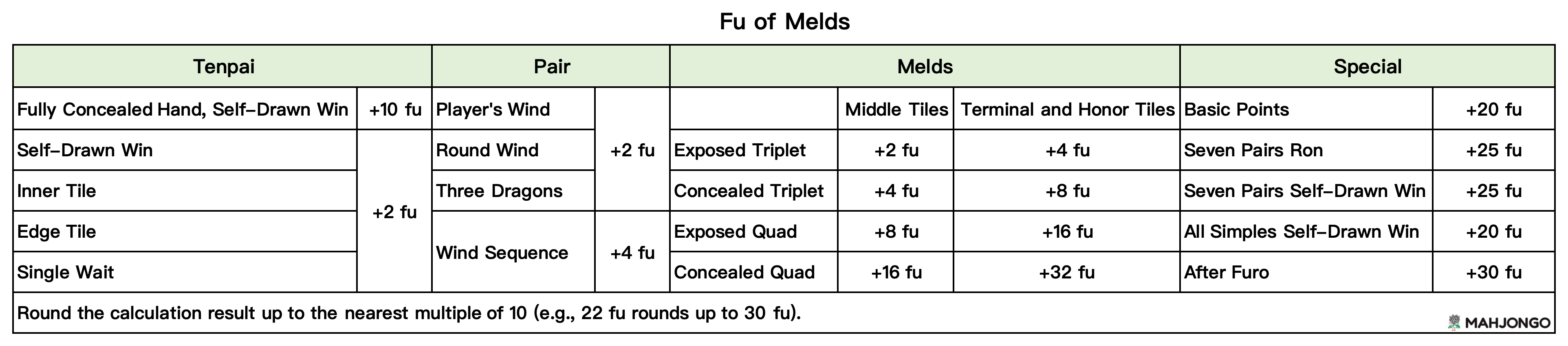
Basic Points
Formula: Basic Points = Fu × 2^(Han + 2).
Limit hands replace the calculated basic points with fixed values:
- Mangan: 5 Han, or a lower-Han hand whose calculated basic points reach 2,000; 2,000 basic points.
- Haneman: 6–7 Han; 3,000 basic points.
- Baiman: 8–10 Han; 4,000 basic points.
- Sanbaiman: 11–12 Han; 6,000 basic points.
- Yakuman: 8,000 basic points. Whether 13 or more counted Han is treated as Yakuman depends on the ruleset.
Each final payment is rounded up to the next 100 points:
- Non-dealer Tsumo: the dealer pays 2 × basic points and each other non-dealer pays 1 ×.
- Non-dealer Ron: the discarder pays 4 × basic points.
- Dealer Tsumo: each opponent pays 2 × basic points.
- Dealer Ron: the discarder pays 6 × basic points.
Scoring Quick Reference
Once the Fu and Han are known, the reference table gives the rounded Ron and Tsumo payments without repeating the full formula.
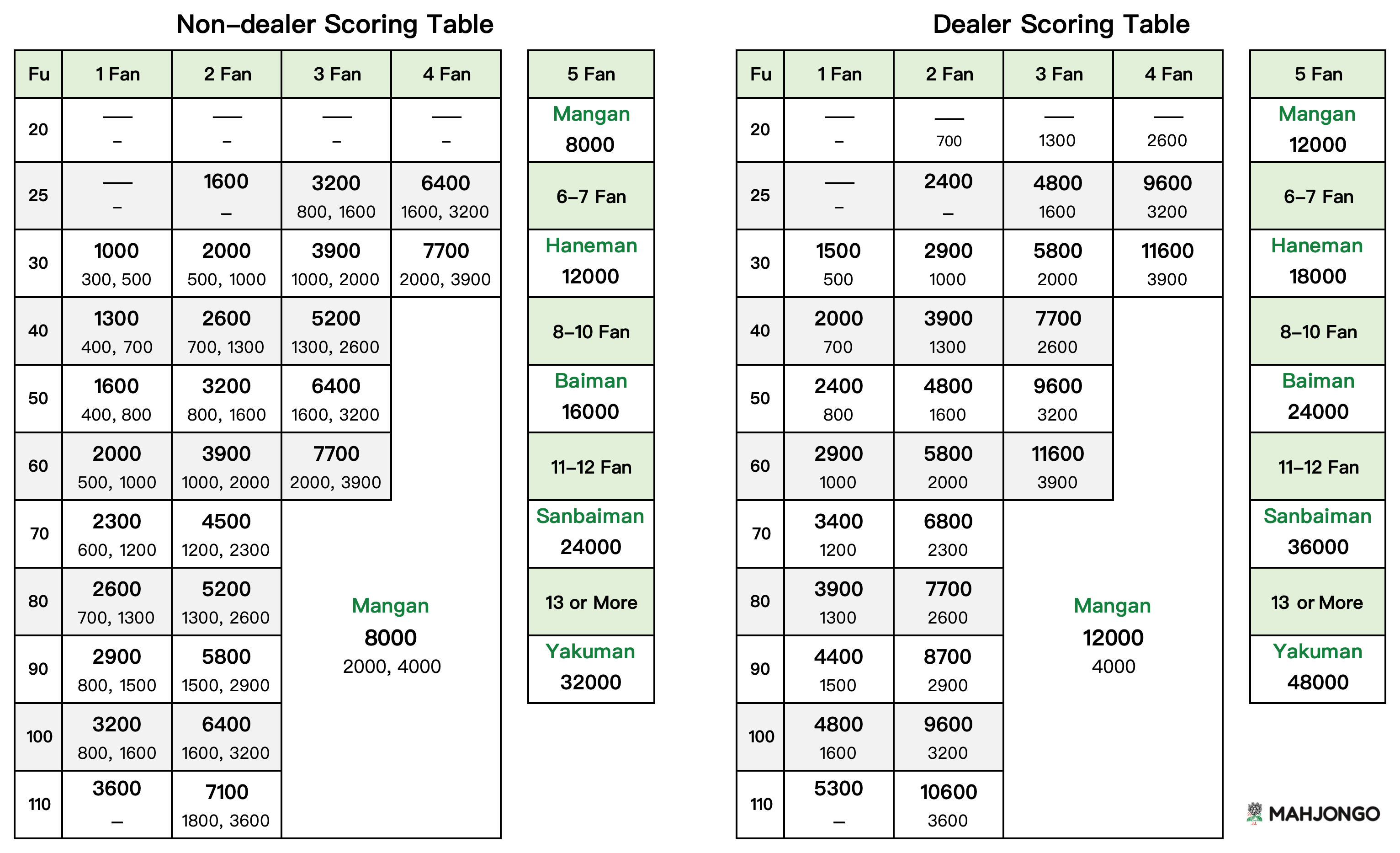
Non-dealer table: the first line is the Ron total; the second line shows the Tsumo payments from a non-dealer and from the dealer.
Dealer table: the first line is the Ron total; the second line is the Tsumo payment from each opponent.
Riichi Mahjong Strategy Tips
Strong play balances hand speed, value, and safety rather than chasing every possible win.
- Track Dora: Use visible indicators and known red fives when estimating hand value and danger.
- Read Discards: Opponent discards, calls, and Riichi timing provide clues about waits and safe tiles.
- Choose Yaku Early: Plan around realistic Yaku so the hand remains legal and efficient.
- Switch Between Attack and Defense: Fold when the expected loss is greater than the value and chance of completing your hand.
- Declare Riichi Deliberately: Consider wait quality, score, dealer position, remaining tiles, and opponent threats before committing.
Riichi Mahjong FAQ
What is Riichi Mahjong?
Riichi Mahjong is a Japanese Mahjong ruleset built around Yaku, Fu, Han, Dora, Riichi declarations, and Furiten.
Why do I need a Yaku?
A structurally complete hand can win only if it has at least one Yaku. Dora adds Han after the hand is legal, but it does not satisfy the Yaku requirement by itself.
What is Furiten?
Furiten prevents a player from winning by Ron in defined situations, including when any current winning tile is among that player’s own discards. Passing on a winning discard can also create temporary Furiten, or permanent Furiten after Riichi. Tsumo remains possible.
What is a Dora indicator?
The indicator is not usually the Dora itself. It points to the next tile in its suit or honor sequence; that next tile is the Dora.
When can I declare Riichi?
You need a closed hand in tenpai and at least 1,000 points. The declaration deposits a 1,000-point stick and commits the hand, subject to limited ruleset exceptions.
How is a score calculated?
First identify the Yaku and total Han, then calculate Fu, apply any limit, multiply for dealer or non-dealer and Ron or Tsumo, and round each payment up to 100 points.
Riichi Mahjong Tools
Use these focused tools to build hands, check scoring, or report a problem.
Special Thanks
dichohecho, D.Koehnen, Hilanderiam, Ken...
Thank you for helping MahJongo improve its Riichi Mahjong experience.