American Mahjong Online
American Mahjong is a four-player tile game built around an annual card of approved 14-tile hands. Jokers, the Charleston exchange, racks, and card-based patterns distinguish it from many Asian Mahjong variants.
This guide explains the stable fundamentals used by MahJongo. The National Mah Jongg League (NMJL) publishes a new Official Standard Hands and Rules card each year, so the exact hands, values, and card-specific restrictions must always be checked against the card for the year being played.
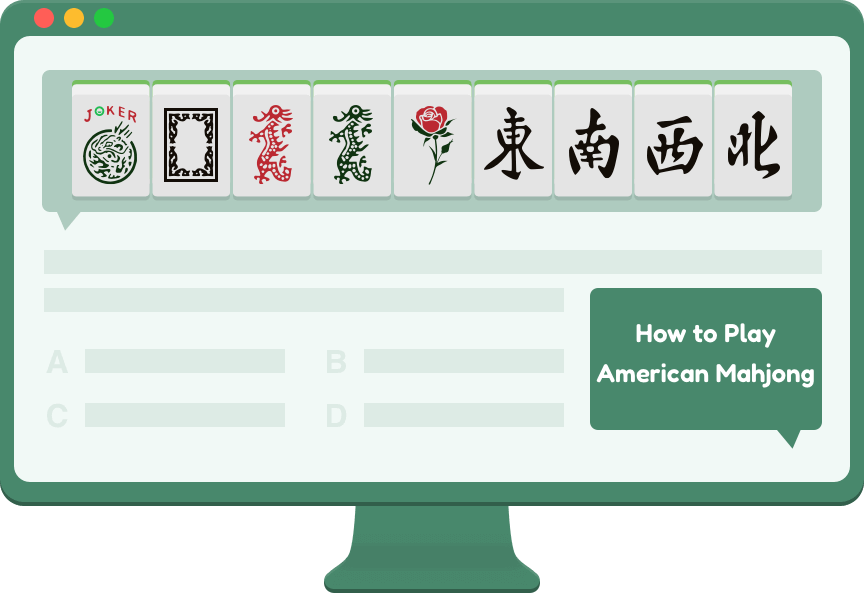
What Makes American Mahjong Different
- Annual card: players build one of the exact hands printed on the card for the current year rather than a general four-meld-and-pair hand.
- 152-tile set: the standard active set adds eight Flowers and eight Jokers to the 136 suited and Honour tiles.
- Charleston: players pass groups of three unwanted tiles before normal drawing and discarding begins.
- Jokers: wild tiles may help complete eligible groups but cannot stand for a single tile or a pair.
- Card notation: numbers, letters, spacing, colors, and concealed or exposed status are all part of a hand’s requirements.
American Mahjong Tiles
The active set contains 152 tiles. Some physical sets also include spare blank tiles, but those spares are not part of the 152-tile playing set.
- Dots, Bams, and Craks: 36 tiles in each suit: four copies of every number from 1 through 9, for 108 suited tiles.
- Winds: four each of North, East, West, and South, for 16 Wind tiles.
- Dragons: four Red, four Green, and four White Dragons; the White Dragon is also called Soap.
- Flowers: eight interchangeable Flower tiles.
- Jokers: eight wild tiles used only where the hand and Joker rules permit.
How to Read the Annual Card
Read every line literally. A winning hand must match the selected line’s tile identities, group sizes, color relationships, and concealed or exposed requirement.
- Group sizes: a Pung has 3 identical tiles, a Kong has 4, a Quint has 5, and a Sextet has 6.
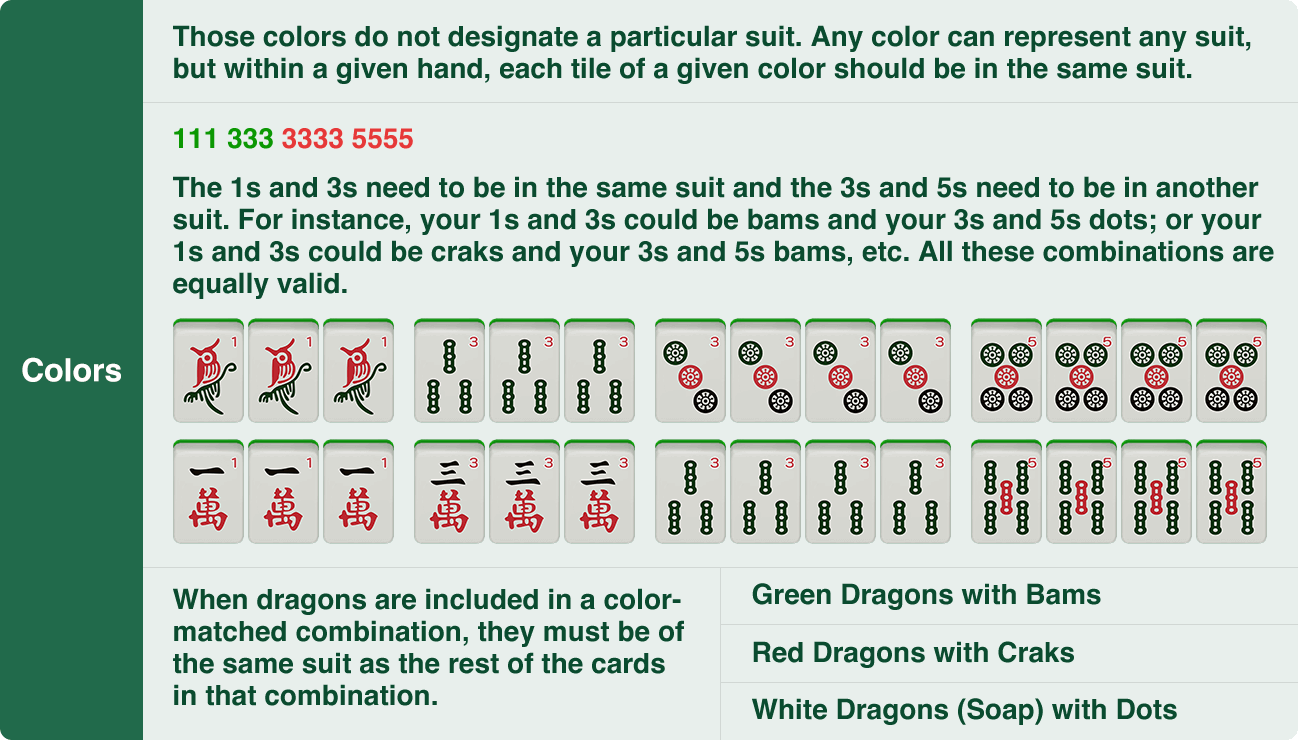
- Colors: card colors do not name fixed suits. The same color must represent the same suit within that hand, while different colors represent different suits.
- Common symbols: N, E, W, and S are Winds; F is a Flower; D is a Dragon; 0 commonly represents the White Dragon or Soap.
- Current year: do not combine instructions from different annual cards. Use the exact card and pattern set selected for the game.
Setup and Turn Flow
- Initial hands: East begins with 14 tiles; the other three players begin with 13.
- After the Charleston: East makes the first discard. Play then continues with each player drawing one tile and discarding one.
- Target hand: the winning 14 tiles must exactly match one complete line on the selected annual card.
- Declare Mah Jongg: when the pattern is complete, the player declares “Mah Jongg” and the hand is checked against the card.
The Charleston
The Charleston is the opening exchange. Follow the on-screen direction for each pass and select exactly three eligible tiles. Jokers may not be passed. If a Courtesy Pass is offered, opposite players may agree to exchange from zero to three tiles. The interface determines which passes are required in the current game.
Joker Rules
- Eligible groups: a Joker may replace a natural tile in a Pung, Kong, Quint, or Sextet unless the selected hand forbids it.
- Singles and pairs: a Joker cannot replace a required single tile or pair.
- Charleston: never pass a Joker during the Charleston.
- Joker exchange: when permitted, a matching natural tile may be exchanged for a Joker already exposed in a valid group.
Calling Discards and Concealed Hands
For an exposable hand, a discard may be called to complete an allowed group and that group is placed on the rack. A discard normally cannot be called only to complete a single tile or pair, except when that discard completes Mah Jongg. A hand marked concealed must remain unexposed; follow the selected card line and the prompts in the current game.
Winning and Scoring
Use the value printed beside the exact completed hand on the selected card. Do not estimate a score from Pungs or Kongs alone. Payments for self-draw, discard wins, Joker-free hands, and table limits can vary by ruleset, so MahJongo displays the result for its current game while physical groups should agree on the current card and settlement rules before play.
Practical Strategy
- Choose a section early: compare your starting tiles with several nearby card lines before committing to one hand.
- Protect flexibility: keep tiles that can serve more than one possible line until the Charleston clarifies your direction.
- Read exposure rules first: calling a discard can make a concealed hand impossible, even if the tiles otherwise match.
- Track natural tiles and Jokers: an exposed Joker may be exchangeable later, while a discarded Joker is permanently lost.
American Mahjong FAQ
Does the American Mahjong card change every year?
Yes. The NMJL issues a new Official Standard Hands and Rules card annually. Use one year consistently throughout a game.
How many tiles are used?
The active set has 152 tiles: 108 suited tiles, 16 Winds, 12 Dragons, 8 Flowers, and 8 Jokers. Spare blanks supplied with some sets are not active tiles.
Why does East start with 14 tiles?
East starts the hand and therefore receives the extra tile needed to make the first discard. The other players begin with 13.
Can a Joker be used in a pair?
No. Jokers may be used only in eligible groups of three or more, subject to the selected hand.
Do the colors on the card always mean the same suits?
No. Colors express suit relationships within a line; they are not permanently assigned to Dots, Bams, or Craks.
Does MahJongo replace the official card?
No. MahJongo provides online play and practice for its supported pattern set. For official NMJL play, consult the current official card and rules.
American Mahjong Resources
Build a sample hand, check the current supported score, or review the all-time leaderboard.
Special Thanks
Thank you for helping MahJongo improve its American Mahjong experience.